
Updates from April
Alan Mathieson, CTO - 2 May 2026 Series: Building the Backbone
April was the month Planner stopped being our shape and started being yours. The headline, reversible data and a full audit trail, got its own post (Nothing Is Ever Gone). But underneath it, a run of releases quietly made the platform far more flexible, and the logistics workflow far more powerful.
Your Fields, Your Festival
No two festivals track the same things. One needs a dietary code on every author; another wants a green-room preference, or a note about which local bookshop is handling signings. We could never guess all of them, so we stopped trying.
Custom Fields let each organisation add its own fields to any record type: people, events, assets, venues, accommodation, travel, equipment, media, documents. Pick from text, email, phone, URL, long text, number, date, date & time, yes/no, single-select or multi-select, and select fields let you define your own options.
You configure them in Settings, group them by record type, drag them into the order you want, and they appear automatically in the right master sheets and detail panels. Because the values are stored right alongside the record, they show up in exports and sort and filter like any other column. Every festival inherits sensible defaults and can override or hide them.
Why it matters: the fastest way to make people abandon a system is to tell them it can't hold the one thing they care about. Now it can hold anything.
The Logistics Schedule Grows Teeth
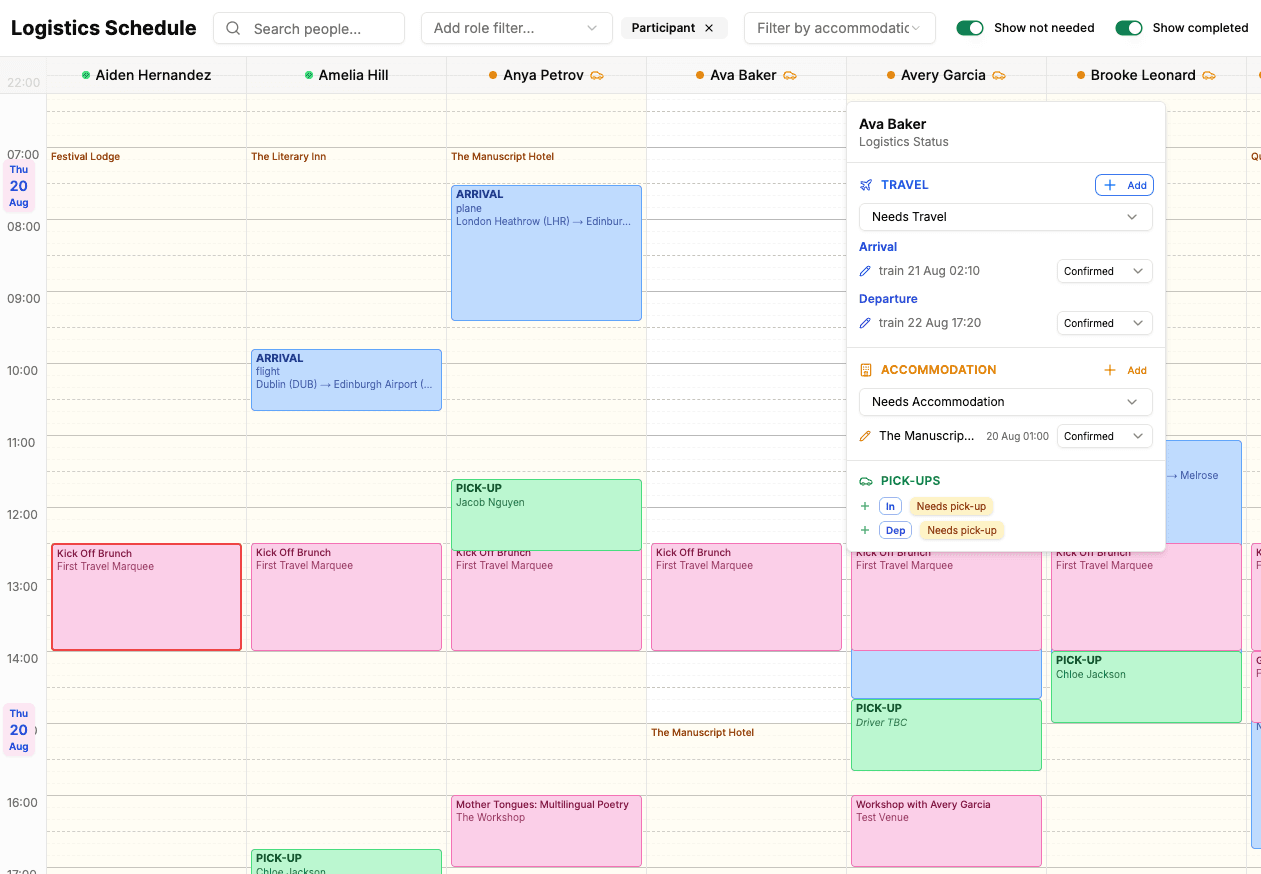
The Logistics Schedule became the command centre for getting people to your festival and looking after them once they're there.
Click any person's column and a popover shows their travel, accommodation and driver status at a glance, editable right there, or with full dialogs a click away. Events appear as pink blocks on the grid wherever that person is an author, chair, interviewer or speaker, and driver pick-ups show as green 30-minute blocks, so you can see at a glance when someone needs collecting. A coloured status dot on each column header tells you instantly: green for all sorted, amber for partway, grey for nothing arranged yet. Add a filter to focus on everyone at a particular hotel, and you've got a live picture of your whole logistics operation on one screen.
Later in the month it got sharper still: create travel and accommodation offers straight from the schedule, hide the rows that are done or not needed so you only see what still wants attention, and clash highlighting, so that when two events for the same person overlap, the second now gets a red border and a "Clash:" hover instead of silently hiding underneath the first.
Stays Get Their Own Home
We split a concept that had always been tangled. Accommodation describes the buildings, the hotels, the flats. The new Stays master sheet records the actual bookings against them: who's staying where, when, and at what status (Offered or Confirmed), with a computed Nights column and all the usual multi-edit, CSV and edition-scoped behaviour.
Modelling it this way means a hotel is reusable year after year, while each booking carries its own status and history. It matches how festivals actually think about accommodation, and it set up the room-sharing and occupancy work that came later.
Alongside it, every master sheet gained a Last Edited column ("2h ago, Lynne") that opens the full change history for that row, and date filters got friendlier: type 15 Aug or Aug 2026 and the right rows appear, no more wrestling with 2026-08-15 and timezone offsets.
The Quiet Work
Live Stream support. Events can now carry a live-stream URL, exposed through the public API as liveStreamUrl and filterable with ?live_stream=true, so your website and apps can flag which events are streaming.
Programme-wide artwork. Festival Artwork and Social Media Images were doing the same job in two places, so we merged them. Admins now see every event's artwork across the whole edition, sorted by time then by biggest venue first; participants and publicists still see only their own.
A pile of scheduling papercuts cleared: venue-clash wording that finally matches the situation, front-of-house notes surfaced on the seating list, and tie-breaks that sort the bigger venue first.
What's Next
With the data model now flexible and the logistics view genuinely powerful, May turned to a different question: what happens when the festival team leaves their desks? Because they always do.
Fesutibaru is building the digital backbone of live culture, starting with book festivals. Curious? Book a demo or get in touch at info@fesutibaru.com.