
Nothing Is Ever Gone
David Ogilvie, CEO - 18 April 2026
Let me tell you about the worst kind of festival phone call.
It's three weeks out. Someone, tired, rushing, doing the job of three people, deletes the wrong thing. An author. A whole venue's worth of events. A travel record that took a fortnight of back-and-forth to pin down. And it's just... gone. The old way of fixing that was a call to whoever ran the database, a restore from a backup taken who-knows-when, and a sinking feeling that you'd lost the last two days of everyone's work along with it.
Twenty years of running a festival taught me that the tools we used were never really ours. They were fragile. One wrong move and you were at the mercy of a backup and a prayer.
Today's release changes that completely. From now on, in Planner, nothing is ever really gone.
Every Delete Is Reversible
Deleting a person, event, asset, venue, accommodation, travel record, document, image, equipment item or pitch no longer wipes it from existence. The record is marked as deleted, hidden from every view, and quietly parked for 30 days. Even the wording has changed: the confirmation now asks "Move to Recycle Bin?" instead of that heart-stopping "permanently delete" warning.
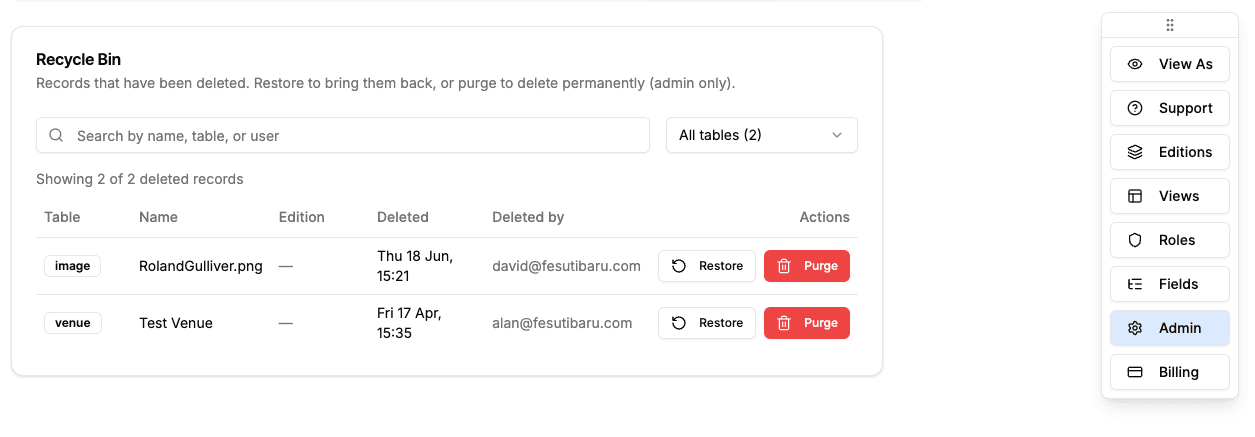
There's a new Recycle Bin, admin only, listing everything that's been deleted, across every kind of record. You can see who deleted what and when, restore it back to active with a single click, or, if you're absolutely sure, purge it for good. Anything older than 30 days clears itself automatically, so the bin never becomes its own mess.
That awful phone call? It's now a ten-second job. Open the bin. Click restore. Done.
Every Change Is Traceable
The second half of this release answers the other question that haunts festival teams: "who changed this?"
There's now an Audit Log, again admin only, that records every change made to your festival's data. Creates, edits, deletes, across the master sheets and the connections between them, and through the events API. Each entry shows who did it, what they did, when, and a side-by-side view of exactly what changed. You can filter by person, by record type, by action, or by date.
No more guesswork. No more "I think it was like that already." When a schedule mysteriously shifts or a contact detail vanishes, you can see the history and know.
And You Can Finally Work in a Spreadsheet Again
I'll admit something. Festival people love spreadsheets. Not because they're good (they're not), but because they're fast for bulk edits. So we stopped fighting that instinct and embraced it.
Every master sheet now has CSV import. Export your data, edit it in Excel or Google Sheets the way you always have, and bring it straight back in, either updating existing rows or adding new ones. You get the speed of a spreadsheet for the big jobs, and the safety of a real system underneath.
Why This Matters
This is the release I'd have begged for a decade ago.
A festival's data isn't just data. It's months of relationships, negotiations and decisions: who's coming, where they're staying, what they need, who to call when it goes wrong. Losing a piece of it isn't an inconvenience. It's real work, and real trust, gone.
Making every delete reversible and every change traceable is what turns a piece of software into something you can actually rely on when the pressure is on. It's the difference between a tool you use and infrastructure you trust.
From today, Fesutibaru is the second kind.
If you run a festival and you've ever had that phone call, I'd love to show you a better way. Book a demo or get in touch at info@fesutibaru.com.