
Updates from June
Alan Mathieson, CTO - 1 July 2026 Series: Building the Backbone
There are two kinds of good release. One adds something you've wanted. The other takes away something you'd stopped noticing was in your way. June did both: a proper home-page editor and a couple of genuinely useful new views, alongside a deliberate, slightly ruthless tidy-up of things that hadn't earned their place.
Every Festival's Welcome Page, Editable
Each festival on Fesutibaru has a Welcome page, the first thing your team sees when they log in. Now you can actually build it.
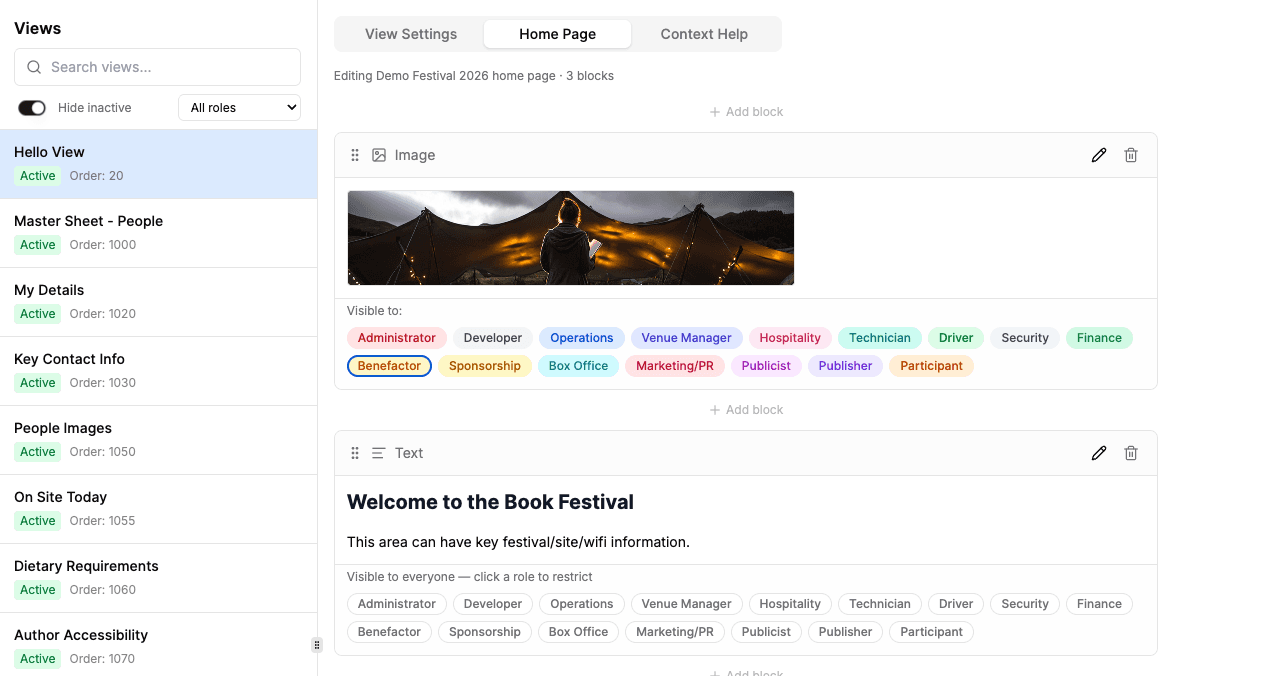
The new Home Page editor (in Settings → Views) lets you assemble the page from four block types: a header image band with an optional overlay title, rich text with headings and lists and links, inline images with captions, and dividers. Every block can be drag-reordered and edited in place, and, the clever part, role-gated. A single page can show a welcome to everyone, an announcement just to admins, and a note just to publicists, all at once. Home pages are edition-scoped, so this year's welcome lives independently of last year's.
Why it matters: the login page is prime real estate. Instead of a generic landing spot, it becomes your festival's own noticeboard: the right message for the right people, refreshed each year.
Two Views for the Days That Matter
On Site Today is a photo board of everyone present on a chosen day: arrivals, events and overnight stays, all in one place. Each presence badge opens a popover with the detail behind it: arrival time and location, the day's events and start times, and where someone's staying with check-in and check-out dates. On a busy festival day, it's the single screen that answers "who's actually here right now?"
Multiple images per event. Events can now hold a gallery instead of a single image; add several, reorder them, set a cover. The table shows a thumbnail stack, the cover flows through to listings and the public site, and the full list comes back through the customer API.
The Tidy-Up
This is the part I'm oddly proud of. We retired a set of features that weren't pulling their weight: the old Accommodation and Travel Checklists (superseded by the Stays Checker and the Logistics Schedule), and the no-code Components system, which never landed where festivals actually wanted it. That last one alone let us delete over 4,000 lines of dead code.
We also consolidated the navigation: Stage Requirements and Venue merged into Stage & Venue; Accommodation and Travel merged into Logistics; a handful of master sheets renamed for brevity. The Views settings were rebuilt around the control people actually touch most, role access, with a "filter by role" dropdown so an admin can answer "what does an Operations user see?" without switching into View As.
Why it matters: a platform that only ever grows eventually collapses under its own weight. Taking things away, carefully, with the better replacement already in place, is how it stays fast and legible. Less to learn, less to maintain, less to go wrong.
The Quiet Work
Security hardening. We upgraded the authentication layer and tightened a set of API routes (authorization, tenant scoping, security headers) following an internal review. And Planner now refuses to save a duplicate email: if someone else in the festival already uses an address, it tells you exactly who, so an accidental mix-up is impossible to create.
Speed and polish. A substantially faster Schedule grid on large programmes, a quicker Event Media view that no longer caps at three files, refreshed Pick Up Details with a day filter and CSV run-sheet export, a read-only Stays Overview for hospitality, and a "show past events" toggle across the event views.
What's Next
Six months in, the backbone is real: reversible data, flexible fields, end-to-end logistics, role-aware everything, and now editable home pages. From here the work turns outward, to the public-facing side of festivals, and to making the data we've so carefully structured genuinely useful beyond the ops team.
That's the next chapter. Thanks for reading along.
Fesutibaru is building the digital backbone of live culture, starting with book festivals. Want to see where it's going? Book a demo or get in touch at info@fesutibaru.com.